

25+ Years of Experience in Commercial Kitchen Equipment Manufacturing
Behind every successful hotel and restaurant is a kitchen built to last. And behind every kitchen that lasts are the right commercial kitchen equipment manufacturers.
The problem is, the Indian market is full of options — big factories, small workshops, traders, and dealers — all claiming to be “manufacturers”. The wrong choice means burners that fail in six months, tables that bend, and hoods that don’t pull smoke properly. The right choice means equipment that runs strong for 10–15 years.
This guide will help hotel owners, restaurant owners, bakery businesses, and canteen operators understand exactly how to spot the right manufacturer — what to check, what to ask, and what most buyers learn only after their kitchen is already installed.

What Are Commercial Kitchen Equipment Manufacturers?
A commercial kitchen equipment manufacturer is not the same as a kitchen supplier or a dealer. A true manufacturer designs, fabricates, tests, and finishes equipment in its own facility — from raw stainless steel sheets to fully assembled cooking ranges, refrigeration units, and exhaust systems.
In India, the difference matters more than buyers realise. A large share of “manufacturers” in the market are actually trading companies that source from multiple small workshops, paste their brand on the equipment, and pass it on. When a Chinese burner stops igniting in month seven, the so-called manufacturer cannot trace the casting batch, the gas valve supplier, or the welder who built the frame.
A real manufacturer can. That single fact decides whether your kitchen runs for three years or fifteen.
Why Choosing the Right Manufacturer Matters
Commercial kitchens run under conditions that domestic kitchens never face. Burners stay lit for 14 hours. Hoods pull oily smoke continuously. Tables get scrubbed with caustic cleaners every night. Steel sinks see hot, cold, and acidic loads back-to-back.
Equipment built without an understanding of this reality fails in predictable ways:
- Gas leakage at burner joints after six to eight months
- Bent table tops due to under-gauge stainless steel
- Exhaust hood vibration caused by poorly balanced motor housing
- Rust on legs and joints when SS 202 is used instead of SS 304
- Door alignment loss on refrigeration units due to weak hinge mounting
Most of these issues are invisible at the time of purchase. They show up only after the warranty has quietly expired.
Key Features to Check Before Buying Commercial Kitchen Equipment
Use this practical checklist when visiting any showroom or factory:
1. Stainless Steel Grade
SS 304 is the standard for food contact surfaces. SS 202 looks identical but rusts within a year in humid kitchens. Always ask for the grade certificate, not just a verbal assurance.
2. Sheet Thickness (Gauge)
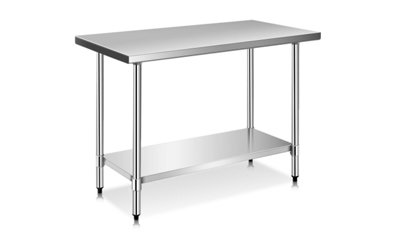
A serious SS work table uses 1.2 mm or 1.5 mm top sheets. Anything below 1.0 mm flexes under load. Tap the surface — a thin sheet sounds hollow.
3. Welding Quality
TIG welding leaves clean, smooth joints. Spot welding or rough arc welding creates corrosion points where food bacteria collect.
4. Burner Pressure Stability
For Chinese burners and three-burner ranges, ask about BTU output and flame retention under continuous use. A well-built burner does not drop pressure after four hours of cooking.
5. Hinge, Caster, and Hardware Quality
Branded hinges, soft-close mechanisms, and load-rated casters separate equipment that lasts a decade from equipment that needs annual repair.
6. Exhaust Hood Suction Capacity
Hood capacity is measured in CFM (cubic feet per minute). An under-sized hood lets smoke escape into the dining area. An oversized one wastes energy and pulls conditioned air out.
7. After-Sales and Service Reach
Ask how long it takes for a service engineer to arrive in your city. Equipment fails on busy nights, not Monday mornings.
Types of Commercial Kitchen Equipment Used in Hotels & Restaurants
A complete commercial kitchen typically includes:
Cooking Equipment
- Chinese burner ranges (for Indian-Chinese cooking)
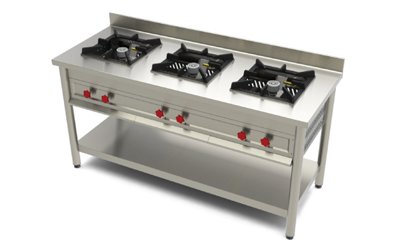
- Three-burner and four-burner gas ranges
- Tandoors (gas and charcoal)
- Combi ovens, pizza ovens, and bakery ovens
- Bain-marie and food warmers
Preparation Equipment
- SS work tables (standard, with under-shelf, or with sink)
- Dough mixers and planetary mixers
- Vegetable cutting tables
- Sink units (single, double, triple bowl)
Refrigeration
- Under-counter chillers and freezers
- Vertical four-door and six-door units
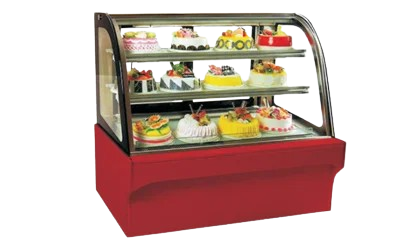
- Display chillers for bakeries
- Walk-in cold rooms
Storage & Display
- Storage racks (4-tier, 5-tier)
- Pickup counters
- Hot and cold display units
Ventilation
- Exhaust hoods with grease filters
- Make-up air systems
- Ducting and chimney systems
Washing
- Commercial dishwashers (under-counter and conveyor type)
- Glass washers
- Pot wash sinks
Hotels and restaurants typically need 60–80 individual pieces in a fully equipped kitchen. Bakeries and canteens need different configurations — but the quality logic stays the same.
Importance of Stainless Steel in Commercial Kitchens
Stainless steel is the foundation of every serious commercial kitchen — and one of the first things experienced commercial kitchen equipment manufacturers are judged on. But not all stainless steel is equal.
SS 304 is the food-grade standard. It contains 18% chromium and 8% nickel, which gives it strong corrosion resistance against salt, acids, and cleaning chemicals. It is the right choice for work tables, sinks, hoods, and any surface in direct contact with food.
SS 202 is cheaper and visually similar but contains less nickel and more manganese. In humid Indian kitchens, especially coastal cities like Mumbai, Chennai, and Kochi, SS 202 starts showing rust spots within 12 months.
SS 430 is magnetic stainless steel, used for non-contact areas like outer cladding. It costs less but should never be used for food preparation surfaces.
A test that works in any showroom: bring a small magnet. SS 304 is non-magnetic. SS 202 is weakly magnetic. SS 430 sticks firmly. This simple check has saved many buyers from costly mistakes.
Commercial Kitchen Solutions for Hotels, Bakeries & Canteens
Different food businesses need very different kitchen layouts.
1.) Hotel kitchens
prioritise multi-cuisine flexibility. A typical setup separates Indian, Continental, tandoor, and bakery sections. Equipment selection focuses on heavy-duty Chinese burners, large combi ovens, and walk-in cold storage.
2.)Restaurant kitchens
are tighter on space. Workflow matters more than equipment count. A well-designed restaurant kitchen places the chef, prep, and pickup in a triangle, with the dishwash zone clearly separated. Pizza oven dealers and combi oven dealers in Delhi increasingly recommend twin-deck setups for restaurants doing both Italian and Indian menus.
3.)Bakery kitchens
depend on temperature precision. A poor-quality bakery oven varies by 15°C from front to back, which destroys consistency in croissants and breads. Bakery equipment manufacturers focus heavily on insulation thickness, door sealing, and steam injection accuracy.
4.)Canteen kitchens
prioritise volume and ease of cleaning. Industrial and institutional canteens often serve 500–5,000 meals per day, so canteen equipment manufacturers design for fast turnover, large bain-maries, and continuous-load dishwashers.
Why Industry Experience Matters in Commercial Kitchen Manufacturing
Manufacturing commercial kitchen equipment is not a generic metal-fabrication job. It is a craft built on years of failure analysis.
A manufacturer with two years of experience can build a stainless steel table that looks identical to one built by a 25-year-old company.
The difference shows up in places the buyer cannot see at delivery time:
- Whether the table legs have internal cross-bracing or just welded straight legs
- Whether the sink corners are radius-welded or sharp-welded (radius corners do not crack)
- Whether the burner gas line uses a brass nipple or a steel one (brass does not corrode)
- Whether the exhaust hood baffles are removable for cleaning or fixed (fixed baffles trap grease)
These details are not in any brochure. They come from watching kitchens fail and redesigning the next batch to fix the failure. Twenty-five years in manufacturing means roughly 25 generations of quiet improvements.
Why Businesses Trust Royal Equipments for Commercial Kitchen Solutions
Royal Equipments – A Unit of Kuche India Elevation Pvt. Ltd. has been part of India’s commercial kitchen equipment industry for over 25 years. The company manufactures from its own facility in Delhi, supplying hotels, restaurants, bakeries, cloud kitchens, hostels, hospitals, and institutional canteens.
What makes the company’s approach different is the link between manufacturing and field experience. Equipment is not designed in isolation. It is shaped by service feedback from kitchens that run 18-hour shifts, by chef inputs from five-star hotel teams, and by the lessons of repairing other brands’ failures over more than two decades.
The company’s product range includes:
- Chinese burner ranges, three-burner ranges, and tandoors
- SS work tables, sink units, and storage racks
- Exhaust hoods with custom CFM ratings
- Bakery ovens, pizza ovens, and combi oven supply
- Commercial dishwasher dealership and installation
- Bain-marie, display counters, and refrieration units
Beyond manufacturing, Royal Equipments also acts as a trusted dealer for combi ovens, pizza ovens, dishwashers, and bakery ovens in Delhi — which means a hotel or restaurant can plan its entire kitchen from one source instead of coordinating between five vendors.
This is the kind of single-window support that becomes valuable when a kitchen opens on schedule, runs without breakdown, and earns its money back faster than expected.
Common Mistakes Buyers Should Avoid
Even experienced restaurant owners fall into these traps:
1. Buying the lowest quote without checking SS grade
A 15% cheaper quote almost always uses SS 202 or thinner gauge sheet. Year two is when the regret begins.
2. Skipping the factory visit
A real manufacturer welcomes factory visits. A trader will give excuses. Always insist on seeing the workshop before placing a large order.
3. Ignoring exhaust hood sizing
Restaurants spend lakhs on cooking equipment and then save ₹40,000 on a too-small hood. Within months, the kitchen ceiling turns black and the dining area smells of food.
4. Mixing brands without compatibility checks
A burner from one company, a hood from another, and a duct from a third often do not balance correctly. Single-source procurement avoids this.
5. Not budgeting for installation, ducting, and gas piping
The equipment cost is only 60–70% of the actual setup cost. Buyers who plan only for equipment quotes face surprises during installation.
6. Choosing aesthetics over workflow
A beautiful kitchen with bad workflow slows service every single day. A plain kitchen with smart workflow earns money every single day.
How Experienced Manufacturers Improve Kitchen Efficiency & Long-Term Business Growth
Good equipment does more than just last longer. It changes the economics of a food business in three ways:
1. Lower downtime = more revenue A burner that fails on a Saturday night costs more in lost orders than the entire burner is worth. Reliable equipment protects peak-hour revenue.
2. Lower energy bills Properly insulated combi ovens, well-sealed refrigeration, and right-sized exhaust hoods can cut a kitchen’s monthly electricity and gas bill by 18–25%.
3. Lower staff turnover Chefs and kitchen staff stay longer in kitchens where equipment works. High-quality stainless steel, smooth-running hoods, and consistent burners reduce daily frustration. This single factor — staff retention — is invisible on the balance sheet but quietly drives every successful kitchen in India.
A well-built kitchen pays for itself in 18–30 months. A poorly built one keeps demanding money for repairs throughout its life.
Frequently Asked Questions
1. What is the difference between SS 304 and SS 202?
SS 304 is food-grade stainless steel with strong corrosion resistance. SS 202 looks similar but contains less nickel and starts rusting within a year in humid kitchens. Always insist on SS 304 for food contact surfaces.
2. How much does a complete commercial kitchen cost in India?
A small QSR kitchen typically costs ₹8–15 lakh. A mid-size restaurant ranges from ₹18–40 lakh. A full hotel kitchen can cross ₹1 crore depending on scale, refrigeration, and exhaust requirements.
3. How long should commercial kitchen equipment last?
Well-built SS 304 equipment from an experienced manufacturer lasts 10–15 years with normal maintenance. Lower-grade equipment often needs replacement within 3–5 years.
4. What is the most common reason for early equipment failure?
Using thinner gauge sheets, SS 202 instead of SS 304, and unbranded hardware. These shortcuts are not visible at delivery but show up clearly within 12–18 months.
5. How experienced is Royal Equipments?
Royal Equipments – A Unit of Kuche India Elevation Pvt. Ltd. has over 25 years of experience in manufacturing commercial kitchen equipment for hotels, restaurants, bakeries, and canteens across India, operating from its own facility in Delhi.
6. What is the right exhaust hood size for a commercial kitchen?
Hood size depends on the cooking line BTU and kitchen volume. A rough estimate is 150–200 CFM per linear foot of cooking equipment, but accurate sizing should always be done by an experienced engineer.
7. Can one company supply the entire kitchen?
Yes — and it is usually the better choice. Single-source kitchens have fewer compatibility issues, faster installation, and one point of contact for after-sales service.
8. Why is TIG welding better than spot welding for kitchen equipment?
TIG welding creates clean, smooth, food-safe joints. Spot or arc welding leaves rough surfaces where bacteria and grease collect, which fails hygiene audits and shortens equipment life.
9. Is it cheaper to import Chinese kitchen equipment?
The unit cost looks lower, but Indian buyers face issues with spare parts, gas pressure mismatch (Indian LPG runs at different pressure than Chinese setups), and lack of local service support. Indian-manufactured equipment is usually more economical over a 5-year period.
10. What is the best way to compare manufacturers?
Visit the factory, ask for SS grade certificates, check welding quality on existing finished products, ask for client references in your city, and confirm service turnaround time before placing an order.
Conclusion
The right commercial kitchen equipment manufacturer is not the one with the cheapest quote or the slickest catalogue — it is the one that uses the correct stainless steel grade, builds with TIG-welded joints, supports its product with service, and brings the field experience of running kitchens, not just selling to them.
In 2026, food businesses that win are the ones that treat their kitchen as a long-term investment, not a one-time purchase. The equipment chosen today decides how the kitchen will perform during peak dinner hours five years from now.